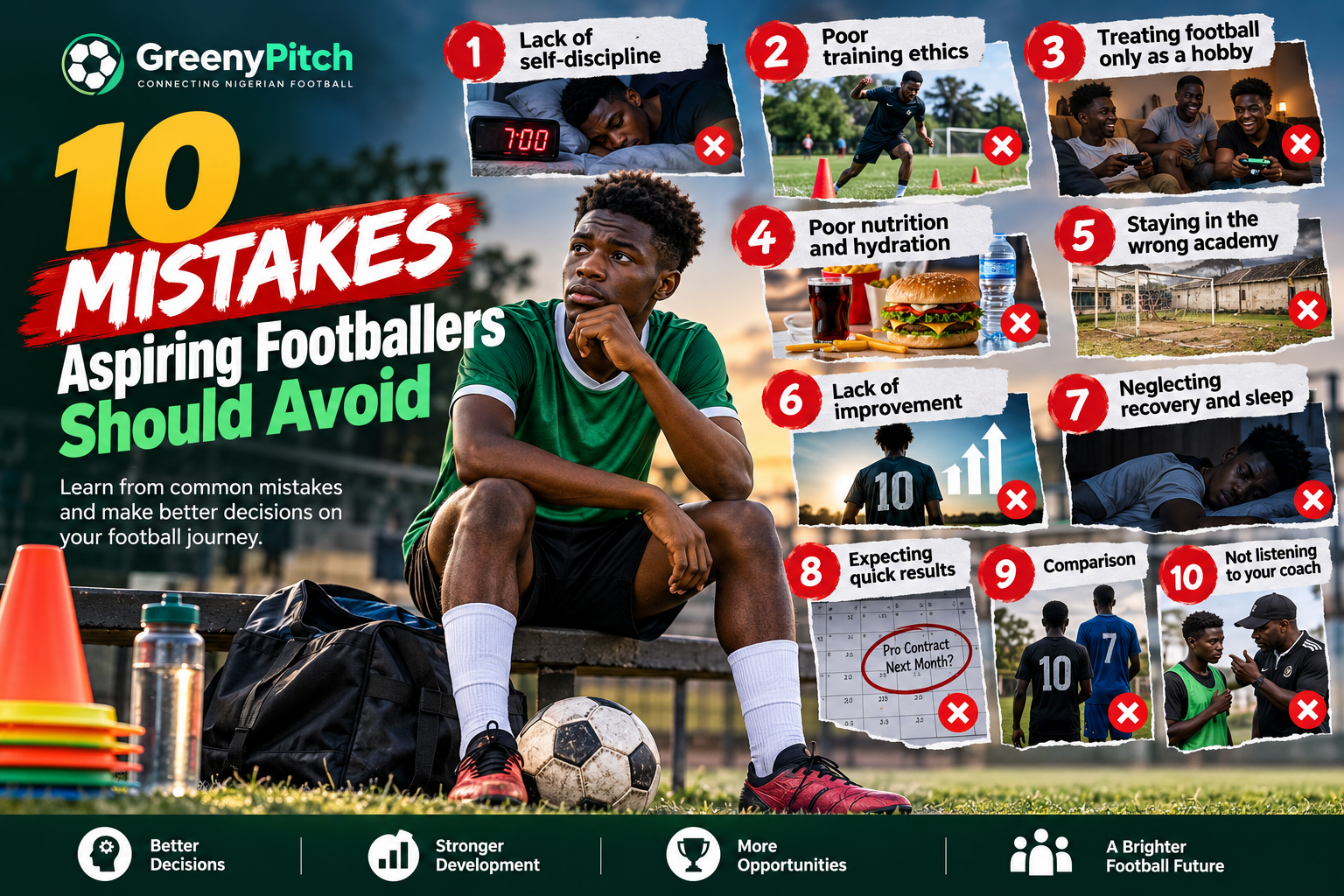
Many young footballers dream of becoming professionals, but talent alone is not enough. In football, some habits help your growth, while others can delay or even damage your progress. If you want to build a serious football career, here are ten mistakes you should avoid.
1. Lack of Self-Discipline
Discipline is one of the foundations of success in football. A player who lacks discipline will struggle to grow, no matter how talented he is. Examples of poor discipline include arriving late for training, going clubbing the night before matches, disrespecting teammates or coaches, and showing a poor attitude during training. Coaches take discipline seriously, and without it, your career can suffer.
2. Poor Training Ethics
Training is one of the building blocks of football success. It may be individual training or team training, but both are important. Individual training helps you improve your technical ability, work on your weaknesses, build confidence, and reduce the risk of injury. Top footballers still spend extra time sharpening their skills, so aspiring players must not become lazy with training.
3. Treating Football Only as a Hobby
Before dreaming of playing for Chelsea, Real Madrid, Arsenal, or Remo Stars, ask yourself an honest question: Am I playing football for fun or as a career? Your career can still be something you love, but not every hobby becomes a profession. If you want football to become your career, then you must approach it with seriousness and create a clear development plan.
4. Poor Nutrition and Hydration
Food and water are essential to a footballer’s performance. A good diet supports energy, recovery, and endurance. If you ignore proper nutrition and hydration, you may become inconsistent, get tired more easily, and become more prone to injuries. Footballers should also avoid certain foods too close to matches, because they can affect performance.
5. Staying in the Wrong Academy
This is one of the biggest problems affecting aspiring footballers. Some academies are more interested in collecting fees than developing players. They may not provide quality exposure, good facilities, or qualified technical staff. Before joining an academy or club, do your research. A good academy should help your development, not just take your money.
6. Lack of Improvement
No footballer should stop improving. Even great players such as Messi and Ronaldo continued working on their game throughout their careers. You may already be good with your left foot, but your right foot can improve. You may be good at short passes, but long passes can get better. You may be a skilled dribbler, but you can become more purposeful with the ball. Improvement must never stop.
7. Neglecting Recovery and Sleep
Training and nutrition are important, but recovery and sleep are just as essential. Your body needs time to repair after training and matches. Good sleep helps build muscle, repair tissues, strengthen the immune system, and improve concentration. A footballer who trains hard but sleeps poorly is limiting his own growth.
8. Expecting Quick Results
Becoming a professional footballer takes time. There is time for learning, time for growth, time for disappointment, and time for patience. No one becomes a professional overnight. Behind every success story are years of practice and struggle. If you attend a scouting programme and are not selected, it does not automatically mean you are not good enough. Sometimes clubs are looking for a specific age, position, or physical profile.
9. Unhealthy Comparison
Comparison can slow down your progress. You may see another player get an opportunity and begin to wonder why it was not you. But instead of comparing yourself with others, focus on your own development. Ask yourself: Am I better than I was last month? Am I fitter? Am I more confident? Have I improved my game? The most important comparison is between who you were before and who you are becoming.
10. Not Listening to Your Coach
One of the fastest ways to grow as a player is to listen to your coach. Coaches help players improve, understand tactics, and stay disciplined. Even if you are one of the best players on the team, a lack of discipline or refusal to follow instructions can cost you your place. For example, your coach may tell you to cross the ball early instead of cutting inside to dribble. If you ignore instructions and keep doing your own thing, you may be punished or dropped from the team.
Conclusion
Every aspiring footballer makes mistakes, but wise players learn early and correct them quickly. Football success is not built on talent alone. It also depends on discipline, training, learning, patience, recovery, and the right decisions.If you want to become a better footballer, start by avoiding these ten mistakes. The earlier you correct them, the better your chances of growth and long-term success.
10 Mistakes Aspiring Footballers Should Avoid

Opeyemi OyekunleOct 25, 2026 | 4 min read | 194 views