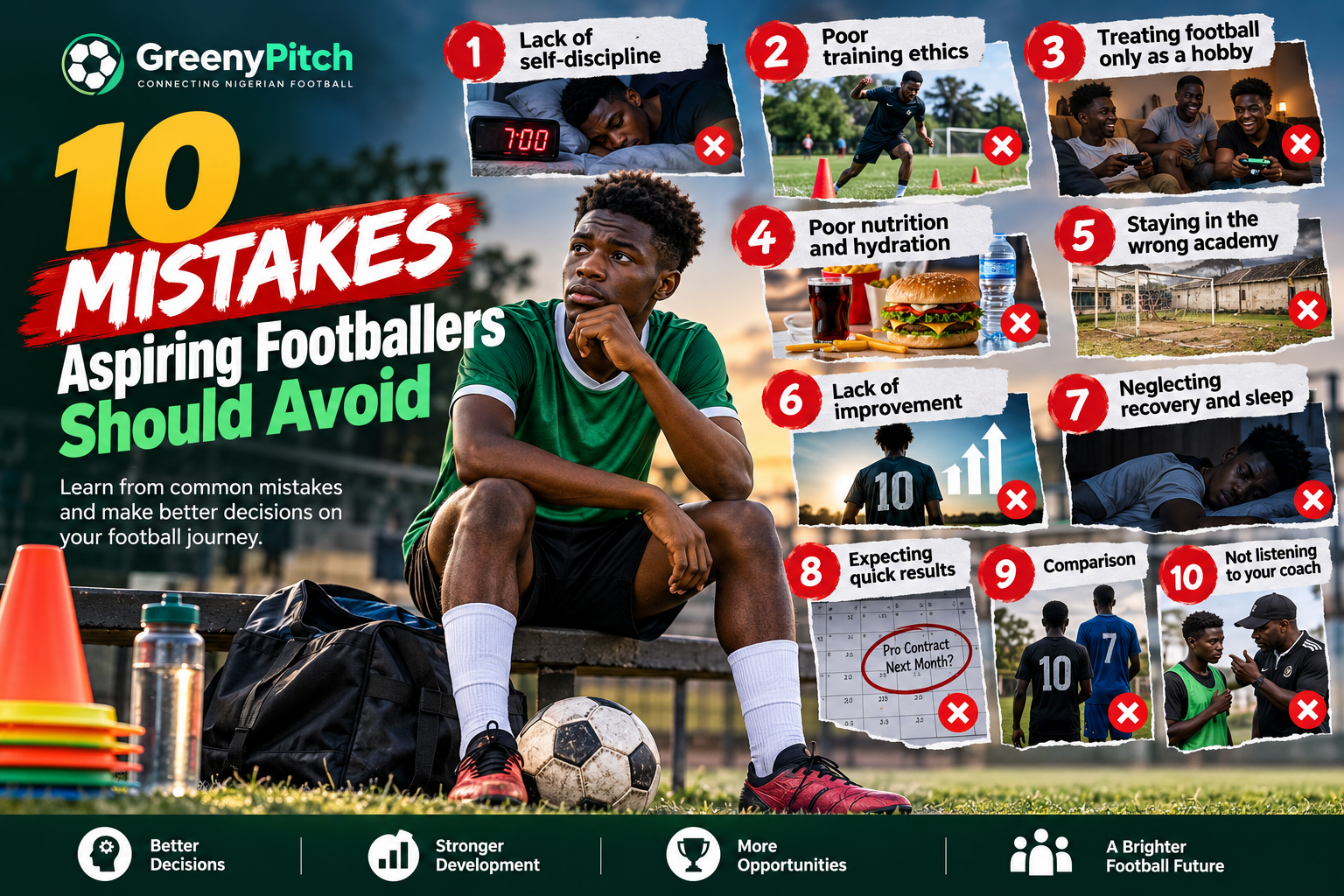
It is easy to admire football stars when they are lifting trophies, scoring important goals, and receiving individual awards. What we often forget is that these players did not become successful overnight. Behind the achievements are years of training, disappointments, sacrifices, injuries, difficult decisions, and countless hours of hard work.
So, what lessons can young Nigerian footballers learn from those who have reached the highest level of the game?
Your Background Does Not Have to Define Your Future
One of the biggest mistakes an aspiring footballer can make is believing that success is reserved for those who come from wealthy families or established football academies. Certainly, having access to good facilities, quality coaching, and financial support can make a player's journey easier, but not having these advantages does not mean the journey is over before it begins.
Take Victor Osimhen as an example. Osimhen grew up in Lagos and faced financial difficulties during his childhood. His football journey eventually took him from the streets of Lagos to the Nigerian youth national team, European football, and the Serie A title with Napoli. In 2023, he was named African Footballer of the Year. Today, his story serves as an inspiration to thousands of young Nigerian footballers who hope to make something meaningful out of their talent.However, there is something important to understand: Osimhen's success did not happen simply because he had a dream. His talent had to be developed, opportunities had to be taken, and difficult challenges had to be overcome.
If you are currently playing for a small football academy or a local team, do not be ashamed of where you are starting. Instead, ask yourself: Am I making the most of the opportunities available to me?
Talent Is Good, but Discipline Is Better
Almost every grassroots football team has that one player everyone talks about. The player who can dribble past three defenders effortlessly. The striker who scores goals from difficult angles. The midfielder whose passes make spectators wonder why a professional club has not signed him.
Yet, being talented does not automatically make someone a professional footballer.Imagine two young players attending the same academy. The first is naturally talented but regularly arrives late for training, argues with coaches, and rarely takes corrections seriously. The second may not be as naturally gifted, but arrives on time, listens carefully, practises consistently, and is always willing to improve.
Who do you think a coach would find easier to develop?
Talent can attract attention, but discipline helps players make the most of opportunities. If your dream is to play for clubs like Chelsea, Barcelona, Real Madrid, or Arsenal, you must begin to develop the habits expected of professional footballers.
You cannot consistently disregard training instructions, disrespect teammates, or refuse to learn and expect to succeed at the highest level.
The discipline you build today may become one of your greatest advantages tomorrow.
Don't Just Train; Train to Improve
There is a difference between attending football training and actually improving as a footballer. Some young players attend training sessions regularly but make little effort to correct their weaknesses. A striker who struggles with finishing keeps practising only dribbling because that is what he enjoys. A midfielder who cannot use his weaker foot avoids situations that require it. Over time, these weaknesses may become serious limitations.
The best footballers understand that improvement requires identifying what needs attention.If you are a defender, how good is your positioning? Can you read the game? Are you comfortable defending against quick attackers? If you are a midfielder, can you control the ball under pressure? Do you understand when to pass, hold possession, or move into space? And if you are a striker, how effective is your movement when you do not have the ball?
You should also learn to ask your coach questions.
After a match or training session, find out what you did well and what you could have done better. Sometimes, the smallest corrections can make the biggest difference.
Training should not be about proving that you are already good. It should be about becoming better than you were yesterday.
Rejection Is Not Always the End of the Road
One of the most difficult experiences for an aspiring footballer is attending a trial and not being selected.
You may have trained for weeks, travelled a long distance, spent money on transportation, and imagined yourself wearing the club's jersey. Then, at the end of the exercise, your name is not on the list. It can be discouraging, especially when you genuinely believe you performed well, but here is something worth remembering, not being selected does not necessarily mean you are a bad footballer.
Sometimes, a club may be looking for players in specific positions. Sometimes, another player may simply perform better on the day. In other cases, you may genuinely have aspects of your game that need improvement. Whatever the reason, try to learn something from the experience. If possible, ask for feedback. Return to training, work on your weaknesses, and prepare for another opportunity.
At the same time, be realistic. Not every trial is legitimate, and no individual should guarantee you a professional contract simply because you have paid a registration fee.
For younger players, parents or guardians should be involved in verifying trials and communicating with organisers.
One unsuccessful trial should not be allowed to define your entire football journey.
Learn from the Best, but Don't Try to Become Someone Else
Ask ten young Nigerian footballers who their favourite player is, and you will probably hear names like Cristiano Ronaldo, Lionel Messi, Victor Osimhen, Ademola Lookman, Kylian Mbappé, and other global stars. There is nothing wrong with admiring these players. In fact, studying their performances can help you develop your football intelligence, but there is a difference between learning from a footballer and trying to copy everything about them.
If you admire Messi, study how he creates space, controls the ball, and makes decisions. If Ronaldo inspires you, pay attention to his movement, positioning, and approach to improvement. However, your abilities, physical development, strengths, and playing style may be different.
A young winger does not have to perform ten stepovers in every match simply because a favourite player does so. Sometimes, a simple pass is the smartest decision.
Football is not only about entertaining spectators. It is also about understanding what the team needs at a particular moment.
Learn from your football heroes, but develop your own identity as a player.
Surround Yourself with the Right People
A young footballer's journey is rarely an individual effort.Behind many successful players are coaches who believed in them, parents who supported their ambitions, teammates who challenged them, and mentors who offered valuable advice. The people around you can influence your football career positively or negatively. For example, a good coach will not simply praise you when you score a beautiful goal. They will also correct you when your positioning is poor or when you make the wrong decision.
A responsible academy should focus on your development, welfare, and education rather than merely promising to send you abroad. This is particularly important in Nigeria, where many aspiring footballers and their families are desperate for opportunities.
Be careful about individuals who claim to have connections with major European clubs but cannot provide credible evidence. Before joining an academy, find out about its coaches, training programmes, competitive opportunities, fees, and track record.
The right environment may not guarantee a professional contract, but it can help you develop properly.
Football Success Is Bigger Than Individual Awards
When we watch the Ballon d'Or ceremony, our attention naturally goes to the individual holding the trophy.
Football is a team sport.
A striker cannot score every goal without the contributions of teammates. A goalkeeper cannot win every match alone. Even the most talented footballer needs teammates who understand their responsibilities.
Yet, some young players become so focused on personal recognition that they forget the importance of teamwork. You may have experienced this during a grassroots match: a player has an opportunity to pass to a teammate in a better position but decides to shoot because he wants to score. Sometimes, that decision costs the team a goal.
Scoring goals and producing impressive performances are important, but knowing when to put the team first is equally valuable.
The Ballon d'Or may be an individual award, but the road to achieving extraordinary things in football often involves collective success.
Be the type of player your teammates enjoy playing with and your coach can depend on.
Dream Big, but Take Your Development One Step at a Time
There is nothing wrong with dreaming of winning the Ballon d'Or. In fact, ambitious dreams can motivate young footballers to work harder, but dreams become more useful when they are supported by realistic goals.
If you are currently playing grassroots football in Nigeria, your immediate priority should not necessarily be securing a contract with Real Madrid. It might be improving your first touch, becoming a regular starter for your academy, participating in competitive tournaments, or earning an opportunity to play at a higher level.
When you achieve one goal, set another.
Remember also that football careers are uncertain. Injuries, competition, personal circumstances, and opportunities can affect even very talented players. This is why education and personal development should remain important alongside football.
You do not need to achieve everything at once.
What matters is that you continue learning, make responsible decisions, and recognise the progress you are making.
Can Nigeria Produce Another Ballon d'Or Winner?
Nigeria has already produced some exceptional football talents.
The late Rashidi Yekini, Nwankwo Kanu, Mikel Obi, Jay-Jay Okocha, Victor Osimhen, Ademola Lookman and many others have demonstrated that Nigerian footballers can compete at the highest level.
In women's football, Asisat Oshoala has also shown what Nigerian players can achieve through talent, determination, and sustained excellence.
The question should not simply be whether Nigeria has enough talented players to produce a future Ballon d'Or winner. We should also ask whether we are doing enough to discover, nurture, and support those players.
How many talented young footballers are playing in communities where there are no qualified coaches?
How many promising players cannot afford transport to regular training sessions?
How many talented girls abandon their football ambitions because they lack encouragement or opportunities?
And how many young players miss legitimate opportunities because they have no access to reliable football information?
These are important questions for football administrators, academies, coaches, parents, and everyone interested in Nigerian football development.
Producing world-class players requires more than talent. It requires a football environment where talent can be identified, developed, and given meaningful opportunities.
Final Thoughts: Every Football Journey Has a Beginning
The next time you watch a Ballon d'Or ceremony, do not focus only on the winner's name or the trophy being presented. Think about the journey!
Think about the training sessions nobody watched, the mistakes that had to be corrected, the disappointments that had to be overcome, and the people who contributed along the way.If you are a young Nigerian footballer reading this, your journey may still be at the grassroots level. Perhaps you are playing for a school team, a local academy, or a community club. That is a starting point, not a final destination.
You may never win the Ballon d'Or, and that is perfectly fine. There are many meaningful achievements worth pursuing in football beyond individual awards. What matters is giving yourself a genuine opportunity to develop your talent, grow as a person, and make the most of the opportunities available to you.
Who knows? Somewhere on a football pitch in Nigeria today, a future world-class footballer may already be taking their first steps.
And that footballer might just be you.
At Greeny Pitch, we believe grassroots football deserves greater visibility and opportunities. Whether you are an aspiring footballer, coach, academy owner, or football enthusiast, visit greenypitch.com to explore and connect with the growing football community.
From Grassroots Football to the Ballon d'Or: What Young Nigerian Footballers Can Learn

Opeyemi OyekunleOct 28, 2026 | 10 min read | 237 views