Why does this happen?
The answer often lies in the difference between football skill and match intelligence.
Imagine two young footballers attending a scouting trial in Lagos. The first player can perform almost every trick with the ball, dribble past opponents, and entertain spectators. The second player may not possess the same flair, but he knows when to pass, where to position himself, when to make a run, and how to exploit spaces.
Who would impress the scout?
The answer depends on what the scout is looking for, but a player who consistently makes effective decisions is likely to stand out, even without spectacular tricks.
Understanding the relationship between football skill and match intelligence is essential for every aspiring footballer.
What is Football Skill?
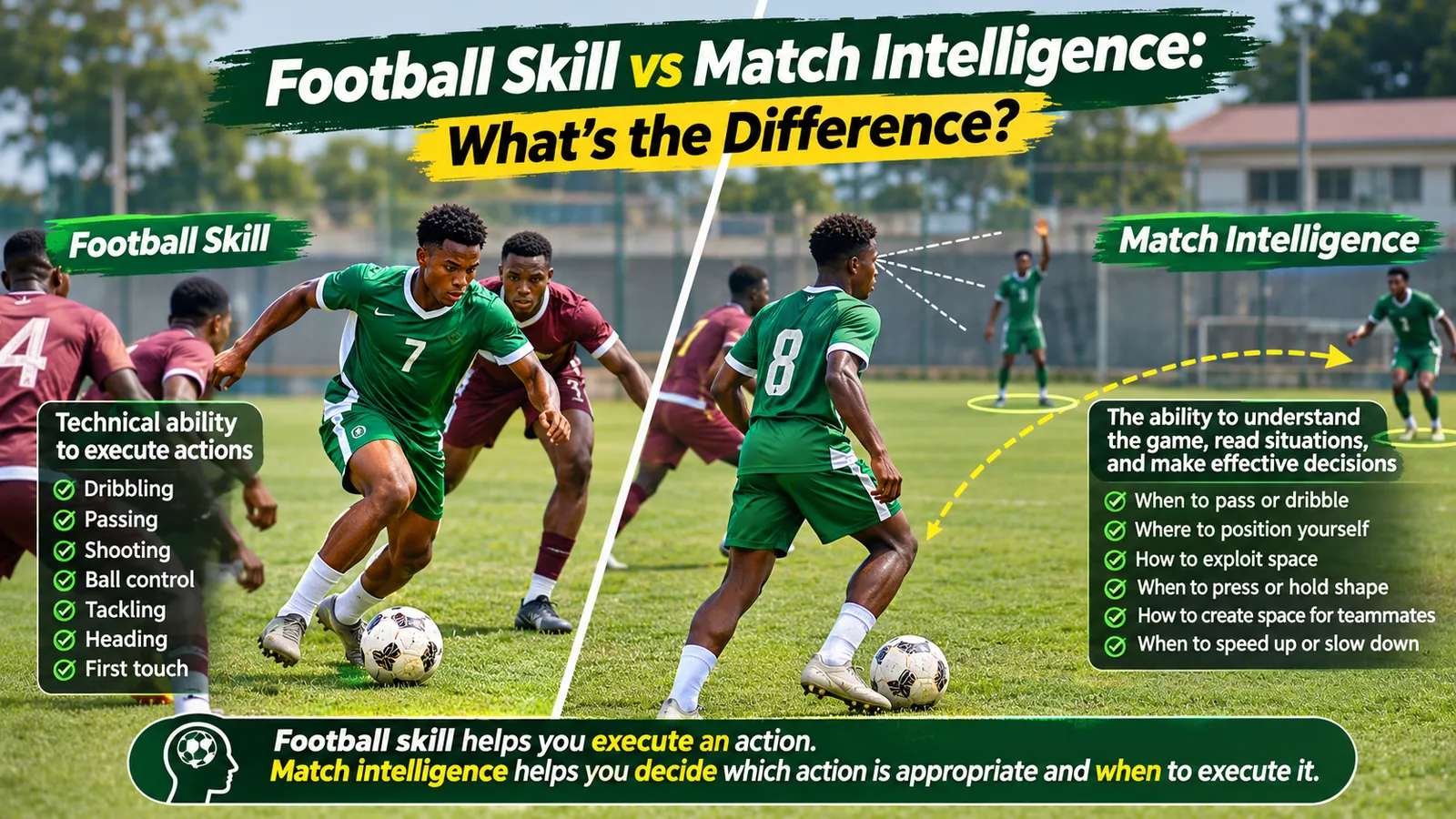
Football skill refers to a player's technical ability to perform specific actions with or without the ball. It involves the physical execution of techniques developed through consistent training, practice, and match experience.
These abilities form the foundation of football performance.
Some important football skills include:
- Dribbling: Moving with the ball while maintaining control, especially when facing opponents.
- Passing: Delivering the ball accurately to teammates over short or long distances.
- Shooting: Striking the ball effectively towards goal.
- Ball control: Receiving, controlling, and manipulating the ball under different conditions.
- Tackling: Challenging opponents to regain possession.
- Heading: Using the head to direct the ball during attacking or defensive situations.
- First touch: Controlling the ball effectively upon receiving it.
A technically gifted player can execute these actions with confidence and precision.
For example, a winger who can dribble past two defenders and deliver an accurate cross demonstrates excellent technical ability.
However, what happens when dribbling is not the best option?
That is where match intelligence becomes important.
What is Match Intelligence?
Match intelligence, sometimes called football intelligence or game intelligence, refers to a player's ability to understand situations, anticipate events, recognise opportunities, and make effective decisions during a match.
It is not simply about knowing football rules or understanding formations. It involves reading the game as it unfolds and responding appropriately.
A match-intelligent player constantly processes information, sometimes before receiving the ball.
Such a player understands:
- When to pass and when to dribble.
- When to shoot and when to retain possession.
- Where to position themselves to receive a pass.
- How to identify weaknesses in an opponent's defence.
- When to press an opponent and when to maintain defensive shape.
- How to create space for teammates.
- When to slow down or increase the tempo of a match.
Consider a midfielder who receives the ball while three opponents are closing in. A player relying mainly on technical ability might attempt to dribble past all three opponents. A player with good match intelligence may have already noticed an unmarked teammate and released the ball with a simple first-time pass.
Both players might possess the technical ability to execute their chosen action. The difference is the decision they make.
Football skill helps you execute an action. Match intelligence helps you decide which action is appropriate and when to execute it. These qualities are closely connected. A player's decision-making is most effective when they also possess the technical ability to execute their decisions.
Can a Skillful Player Lack Match Intelligence?
Absolutely.
A player can possess outstanding technical ability while struggling to make effective decisions during competitive matches. This is particularly noticeable among some young footballers who focus heavily on individual skills.
Imagine a player who repeatedly dribbles past opponents but rarely passes to teammates in better scoring positions. The player may receive applause from spectators because of the impressive dribbling. However, the team could lose valuable goalscoring opportunities.
Similarly, a midfielder might possess excellent passing accuracy but struggle to recognise when to release the ball. Such a player may eventually lose possession despite having the ability to deliver an accurate pass.
This explains why technical ability alone does not guarantee success. Football is a team sport, and individual brilliance must contribute to collective performance.
Can a Player Have Match Intelligence Without Exceptional Technical Skills?
Yes.
Not every intelligent footballer is an outstanding dribbler or possesses extraordinary flair. Some players distinguish themselves through positioning, anticipation, movement, and their understanding of the game. For example, a defender who anticipates an opponent's movement and intercepts a pass may prevent a dangerous attack without attempting a difficult tackle. Likewise, a striker who understands when and where to make a run can create goalscoring opportunities without needing to dribble past several defenders.
However, match intelligence does not eliminate the importance of technical development. A player may recognise the perfect pass but fail to execute it because of poor passing technique.
The most effective footballers develop both qualities.
Examples From Professional FootballSeveral successful footballers demonstrate how technical ability and match intelligence complement each other.
Lionel Messi: Skill and Intelligence Combined
Messi is widely recognised for his extraordinary dribbling, close control, passing, and finishing. Beyond these abilities, his understanding of space, timing, and opponents' movements helps him create opportunities for himself and his teammates. His effectiveness comes not merely from what he can do with the ball, but from knowing when and how to do it.
Thomas Muller: The Importance of Positioning
Muller built much of his reputation on intelligent movement and finding space. His ability to appear in dangerous positions illustrates how understanding space can be as valuable as elaborate technical tricks. He demonstrates that effective movement can make a player extremely difficult to defend against.
Xavi Hernández: Thinking Before Receiving
Xavi was known for his passing accuracy, awareness, and ability to control the tempo of matches. He frequently scanned his surroundings before receiving the ball, helping him identify passing options and make quick decisions. His career demonstrates how awareness and technical precision can work together.
Why Do Some Talented Grassroots Footballers Struggle at Higher Levels?
Across local pitches, school competitions, football academies, and community tournaments, we regularly see players with impressive technical abilities. Some can dribble exceptionally well, others possess powerful shots or outstanding ball control. However, transitioning from grassroots football to professional football requires much more than displaying individual talent.
As the standard of competition increases, players generally face greater tactical demands, faster decisions, more organised opponents, and less time on the ball. A dribbling technique that works against an inexperienced defender may become less effective against a well-organised defensive unit. Similarly, a striker who scores regularly in informal matches may struggle against defenders who anticipate movements and maintain disciplined positioning.
This does not necessarily mean the player has lost their technical ability, it may mean their understanding of the game needs further development.
For aspiring Nigerian footballers, this is an important lesson: being the most skillful player on the pitch does not automatically make you the most effective player.
How Can Young Footballers Improve Their Match Intelligence?
Match intelligence can be developed through structured training, competitive experience, observation, and reflection.
Here are six practical ways to improve.
1. Watch Football With a Purpose
Watching football should go beyond entertainment. Rather than focusing only on goals, skills, and spectacular moments, observe how professional players move and make decisions. Pay attention to players who operate in your preferred position. For example, if you are a defensive midfielder, study how experienced midfielders position themselves when their team has possession and when it loses the ball. Ask yourself why they choose certain passing options and how they react to pressure.
2. Practise Scanning Before Receiving the Ball
Scanning means checking your surroundings to gather information about teammates, opponents, and available space. A player who looks around before receiving the ball is better prepared to make a decision.
During training, practise checking your surroundings before receiving passes. This habit can improve your awareness and reduce unnecessary hesitation.
3. Participate in Small-Sided Games
Small-sided games such as 3v3, 4v4, and 5v5 can help players develop decision-making. These games often create frequent situations where players must receive, pass, move, defend, and react under pressure. Coaches can introduce conditions such as limited touches or additional points for successfully switching play to encourage specific decisions.
The objective is not simply to play faster, but to recognise the appropriate action in each situation.
4. Learn Basic Football Tactics
Understanding football formations and tactical principles helps players recognise their responsibilities.
A winger should understand when to maintain width and when to move into central areas, a defender should recognise when to step forward and when to drop back, a midfielder should know how to create passing angles and support teammates. You do not need to become a professional coach to understand these concepts.
Start with the tactical responsibilities of your preferred position.
5. Analyse Your Own Performances
After every competitive match, reflect on your decisions.
Consider situations where you lost possession, missed a passing opportunity, or failed to position yourself correctly. If possible, review recordings of your matches. Identify what you did well and what you could have done differently.
This helps transform match experience into meaningful learning.
6. Listen to Coaches and Accept Corrections
A good coach does more than teach players how to pass, shoot, or dribble. Coaches also help players understand why certain actions are appropriate in different situations. When a coach corrects your positioning or questions your decision, seek to understand the reasoning.
Constructive feedback can improve your football understanding.
What Should Football Academies Focus On?
Football academies play an important role in developing both technical ability and match intelligence. Training sessions should not focus exclusively on dribbling drills, shooting practice, and physical conditioning. While these activities are important, young footballers also need opportunities to solve realistic match problems.
Academies can encourage match intelligence through tactical discussions, small-sided games, positional exercises, video analysis, and decision-making drills.
For example, rather than repeatedly instructing a winger to cross the ball, a coach can create training situations requiring the winger to decide whether to cross, pass backwards, dribble, or shoot. Such exercises encourage players to think independently.
Developing intelligent footballers requires teaching players not only what to do, but also why and when to do it.
Conclusion: Great Footballers Don't Just Play, They Think
Football is not only played with the feet; it is also played with the mind.
The ability to dribble, pass, shoot, and control the ball is important, but understanding when, where, and why to perform those actions can make an enormous difference.
For aspiring Nigerian footballers hoping to progress from grassroots competitions to professional football, technical development should go hand in hand with tactical understanding and decision-making.
The next time you step onto the pitch, do not focus only on how many opponents you can dribble past or how many spectacular shots you can attempt. Pay attention to your positioning, your teammates' movements, available spaces, and the decisions you make.
Because ultimately, football skill determines what you can do with the ball, while match intelligence helps you understand what you should do with it.