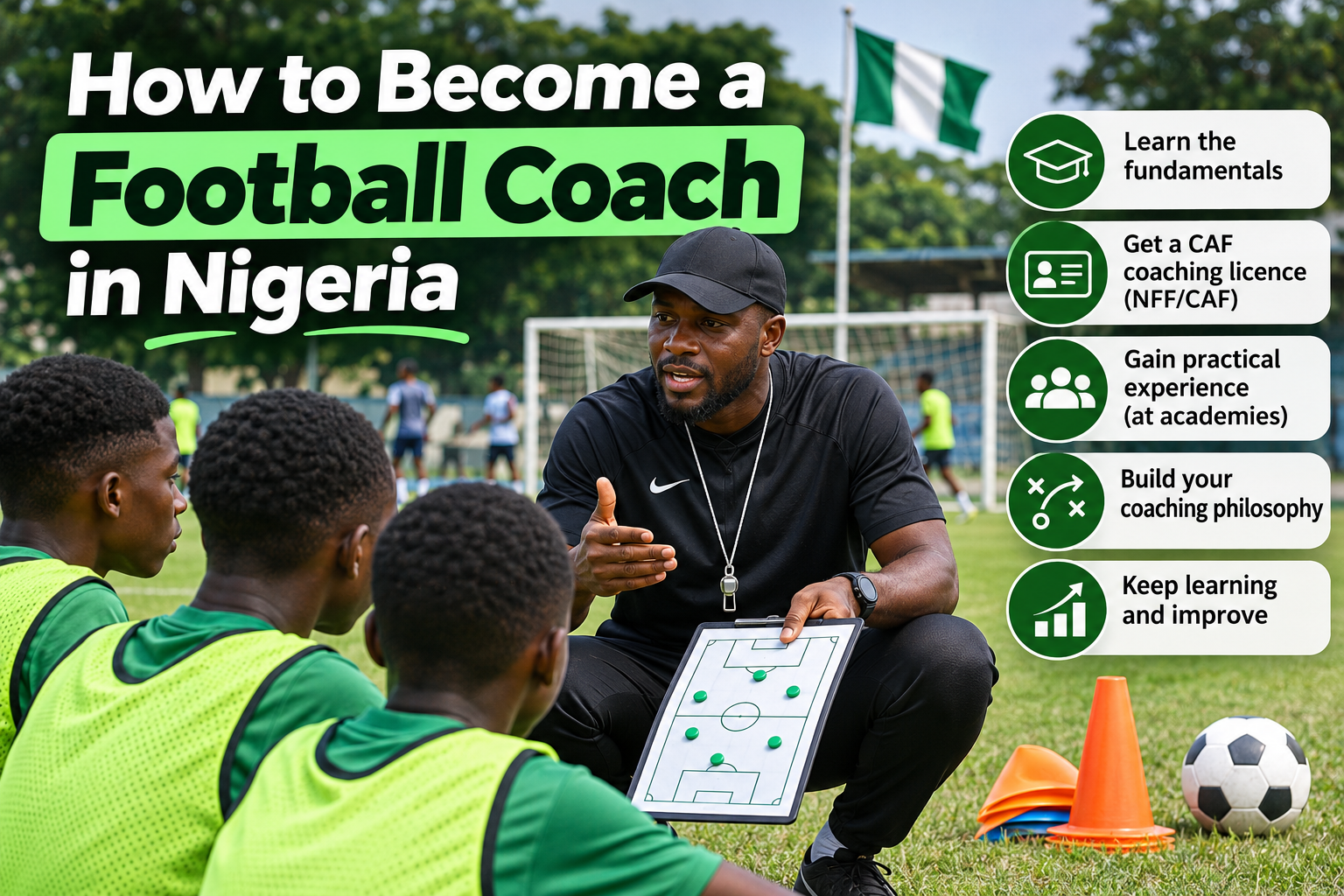
In Nigeria, millions of young people dream of becoming professional footballers. However, not everyone who loves football will become a professional player. Some may discover that their greatest contribution to the game lies not in scoring goals but in developing the next generation of football stars.
How does someone become a football coach in Nigeria? Do you need to have played professional football? What qualifications are required? How much does coaching education cost, and where can you begin?
This guide explores the practical steps aspiring football coaches can take to build a career in Nigeria.
1. Understand What Football Coaching Really Means
Many people assume that being a football coach is simply about selecting eleven players, giving instructions from the touchline, and making substitutions during matches. In reality, coaching involves much more.
A football coach is responsible for developing players technically, tactically, physically, and mentally. Coaches must understand the game, identify players' strengths and weaknesses, develop training programmes, and create an environment that encourages improvement.
- Some important responsibilities include:
- Planning and conducting training sessions.
- Teaching football techniques and tactical principles.
- Identifying and developing talented players.
- Analysing matches and evaluating performances.
- Building team discipline, confidence, and cooperation.
- Protecting players' physical and emotional well-being.
- Communicating effectively with players, parents, and club management.
At the grassroots level, coaches have an additional responsibility: helping young players develop good habits, self-confidence, and a genuine understanding of football.
2. Do You Need to Be a Former Professional Footballer?
No. You do not need to have played professional football to become a football coach in Nigeria.
Although playing experience can be an advantage, it is not a compulsory requirement for starting a coaching career. Former footballers may understand certain aspects of the game through personal experience, but coaching requires additional skills that playing alone does not automatically provide.
For example, a talented former striker might understand goalscoring perfectly but struggle to explain positioning, defensive organisation, or tactical principles to young players. On the other hand, someone who never played professionally could become an excellent coach through education, observation, experience, and commitment.
What matters most is your willingness to learn, your understanding of football, and your ability to help players improve.
3. Start by Learning the Fundamentals of Football
Before applying for coaching positions, develop a solid understanding of football. Watching matches is useful, but watching football as an aspiring coach is different from watching it as a supporter. Instead of focusing only on goals and individual performances, pay attention to how teams are organised.
Ask yourself:
- Why does a team adopt a particular formation?
- How do players create space when attacking?
- What happens when a team loses possession?
- How do defenders maintain their shape?
- Why does a coach make certain substitutions?
- How do teams respond when their original tactics are unsuccessful?
You should also study the Laws of the Game, basic football tactics, player development, training methods, communication, and injury prevention.
The International Football Association Board (IFAB) publishes the official Laws of the Game, which can be accessed through their website.
You can begin developing your coaching knowledge even before enrolling in a formal coaching course.
4. Obtain Recognised Football Coaching Qualifications
If you want to build a long-term coaching career, obtaining recognised coaching qualifications is an important step.
In Nigeria, the Nigeria Football Federation (NFF) oversees football administration and organises coaching education programmes in accordance with the framework established by the Confederation of African Football (CAF). CAF offers different coaching licence levels, designed to prepare coaches for increasingly demanding responsibilities.
For someone beginning a coaching career, the CAF D Licence is a logical starting point when an approved course is available. As you acquire experience and satisfy the requirements for further training, you can progress to higher levels.
It is important to understand that coaching licences are not automatically awarded after paying registration fees. Applicants may need to complete practical sessions, theoretical assessments, and other requirements.
A significant development in Nigerian coaching education occurred in May 2026, when CAF approved Nigeria's return to the CAF A Coaching Convention after a nine-year absence. This allowed the NFF to resume organising CAF A courses locally.
CAF coaching licence pathway:
- CAF Pro Licence for elite professional football
- CAF A Licence for advanced and elite-level coaching
- CAF B Licence for youth and senior amateur football
- CAF C Licence for youth football development
- CAF D Licence for Grassroots and beginner coaching
5. Gain Practical Experience at a Football Academy
One of the best ways to become a football coach in Nigeria is to start at the grassroots level.
Nigeria has numerous football academies, community clubs, school teams, and youth development programmes. These organisations provide opportunities for aspiring coaches to acquire valuable practical experience.
If you are just starting, consider approaching a football academy in your community and expressing your interest in becoming a volunteer or assistant coach. You might begin by helping an experienced coach set up training equipment, supervise drills, organise players, and observe training sessions. As you become more knowledgeable, you may gradually receive opportunities to lead certain activities under appropriate supervision.
Working with an established academy also helps you understand how football development works beyond the classroom.
For aspiring coaches who do not know where to begin, Greeny Pitch's football community platform can provide a starting point for discovering football stakeholders and exploring opportunities to connect with people in the industry.
6. Learn How to Develop Young Footballers
A professional footballer may already understand tactical instructions, physical conditioning, and the demands of competitive football. A young player who is just beginning needs a more patient and development-focused approach. For example, teaching an eight-year-old footballer should involve simple instructions, enjoyable activities, and age-appropriate technical development.
Young players should not be treated like professional athletes whose only responsibility is to win matches.
Good youth coaching should encourage:
- Ball control, passing, dribbling, and coordination.
- Creativity and independent decision-making.
- Teamwork, discipline, and respect for others.
- Enjoyment and confidence.
- Safe, age-appropriate physical activities.
- Equal opportunities for boys and girls to develop.
Coaches working with children should also receive safeguarding training, follow child-protection procedures, and maintain professional boundaries with players.
An aspiring coach who understands how to develop young players can make a meaningful contribution to Nigerian grassroots football.
7. Build Your Coaching Philosophy
Every football coach should gradually develop a coaching philosophy. Your coaching philosophy represents the principles, values, and playing ideas that guide your decisions. For instance, some coaches prefer possession-based football, while others emphasise quick transitions, pressing, or direct attacking football. However, a coaching philosophy goes beyond tactics. It also includes how you treat players, handle discipline, manage disagreements, and respond to victories and defeats.
Ask yourself:
- What kind of football do I want my team to play?
- What values should my players demonstrate?
- How will I handle a talented player who lacks discipline?
- How will I support a player who is struggling to develop?
- Will I prioritise winning youth competitions over the long-term development of my players?
Your answers will help shape your coaching identity.
While it is useful to study successful coaches such as Pep Guardiola, Carlo Ancelotti, and José Mourinho, you should avoid simply copying their methods without considering your players' abilities and circumstances.
A good coach adapts football knowledge to the needs of the team.
8. Develop Important Skills Beyond Football Tactics
Technical knowledge alone does not make someone a successful football coach.
Coaches interact with players, parents, club administrators, match officials, and sometimes the media. Consequently, several personal and professional skills are necessary.
Communication: You must be able to explain instructions clearly and listen to your players.
Leadership: Your behaviour should encourage discipline, trust, responsibility, and teamwork.
Patience: Different players develop at different rates. A struggling player may need encouragement and additional guidance.
Organisation: Coaches must plan training programmes, manage schedules, and monitor progress.
Emotional intelligence: You should be able to manage pressure, disappointment, disagreements, and players' emotions.
Analytical thinking: Understanding opponents, evaluating performances, and adjusting tactics are essential responsibilities.
Integrity: Treat players fairly, avoid favouritism, and act professionally, especially when working with children.
A coach who understands football tactics but cannot manage people may struggle to build a successful team.
9. Create a Coaching Portfolio
As you gain experience, begin documenting your coaching journey. A coaching portfolio can demonstrate your knowledge, practical experience, achievements, and professional development to prospective employers.
Your portfolio may include your coaching qualifications, football-related training, previous roles, teams you have assisted, and areas of specialisation. You can also include sample training plans, tactical approaches, and examples of player development work.
If you have contributed to the improvement of a player or team, explain your role and the progress achieved, without exaggerating your contribution.
For example, rather than simply claiming to have developed several professional footballers, describe the training programmes you helped implement and the measurable improvements observed.
A professional portfolio can strengthen your credibility when applying for coaching positions.
10. Explore Different Football Coaching Career Opportunities
Becoming a football coach does not necessarily mean becoming the head coach of a professional club.
There are different coaching specialisations and career paths in Nigeria.
You may work as a:
- Grassroots football coach.
- Football academy coach.
- School football coach.
- Assistant coach.
- Goalkeeping coach.
- Youth development coach.
- Technical or tactical coach.
- Fitness and conditioning coach, with appropriate specialist qualifications.
- Women's football coach.
- Professional club coach.
Some coaches eventually establish their own football academies, while others specialise in identifying and developing players for higher levels of competition. Each pathway has different demands and opportunities.
For example, coaching a school team may require an educational approach, while coaching a professional club involves advanced tactical preparation, performance analysis, and competitive pressure.
Your career direction should influence the training, qualifications, and experience you pursue.
11. Build Relationships Within the Football Industry
Football coaching is not a career that develops entirely in isolation, building meaningful professional relationships can expose you to opportunities, knowledge, and mentorship.
Attend local football matches, coaching workshops, grassroots competitions, and development programmes. Connect with experienced coaches, academy administrators, and other professionals who can offer guidance.
You can also volunteer during football tournaments and youth development activities. Show genuine interest in learning, contribute where possible, and build a reputation for reliability and professionalism.
Over time, these relationships may lead to coaching opportunities or referrals.
12. Continue Learning and Improving
Football is constantly evolving. Training methods, tactical approaches, player development systems, and performance analysis techniques continue to change.
A coaching qualification is an important milestone, but it should never mark the end of your education. Read coaching books, watch educational football content, attend approved refresher courses, and study matches from different leagues.
You should also reflect on your own coaching sessions. After training, ask yourself what went well, what players struggled with, and how the next session can be improved.
Successful coaching requires continuous learning.
Your Coaching Journey Can Start Today
The future of Nigerian football depends not only on discovering talented players but also on developing knowledgeable, qualified, and responsible coaches.
Whether your ambition is to coach children at a community football academy, work with a school team, or eventually manage a professional club, the journey begins with learning and gaining experience. You do not need to have played in the Premier League or represented Nigeria internationally before you can make a difference. What you need is a genuine passion for developing players, a willingness to learn, patience, discipline, and a commitment to professional growth.
Remember, a great coach does not simply build a winning team, a great coach helps build better footballers and better people.
And perhaps, somewhere in Nigeria today, the next great football coach is preparing to begin that journey.